[{"schema_version":1,"slug":"how-to-visit-evora-from-lisbon-one-day-guide","title":"How to Visit Évora from Lisbon: A One-Day Guide","meta_title":"How to Visit Évora from Lisbon: One-Day Guide | LisTours","meta_description":"Plan a day trip from Lisbon to Évora with practical transport options, a one-day itinerary, key sights and tips for exploring the Alentejo capital.","excerpt":"Plan an independent day trip from Lisbon to Évora, compare train, coach, car and private transport, and organise the historic centre into a realistic one-day route.","canonical":"https://listours.pt/guides/how-to-visit-evora-from-lisbon-one-day-guide/","destination":"Évora","content":"\u003cp>Évora is one of the most practical ways to experience the Alentejo on a day trip from Lisbon. Its compact historic centre brings Roman remains, medieval streets, churches and broad squares together inside a walkable area. UNESCO has listed the Historic Centre of Évora as a World Heritage site since 1986, recognising a city shaped by more than two millennia of history.\u003c/p>\n\u003cp>This guide explains how to travel from Lisbon to Évora independently, how to organise the main sights into one realistic day and when a private tour may be the more comfortable option. Opening hours, ticket rules and transport schedules can change, so check the official links shortly before travelling.\u003c/p>\n\u003ch2>Is Évora worth a day trip from Lisbon?\u003c/h2>\n\u003cp>Yes, particularly if you want a historic inland city that feels distinct from Lisbon without building an overnight stay into your trip. Évora's main monuments are concentrated in and around the historic centre, so a full day can cover the essential landmarks at a sensible walking pace.\u003c/p>\n\u003cp>The value of the trip is not only the number of monuments. The transition from Praça do Giraldo to narrow lanes, whitewashed houses and the Roman Temple gives the city a clear sense of place. The \u003ca href=\"https://whc.unesco.org/en/list/361\" rel=\"nofollow noopener noreferrer\">UNESCO listing for Évora\u003c/a> provides useful background on the city's Roman origins and later development.\u003c/p>\n\u003cp>A day trip does require choices. Adding a winery, a long lunch and every museum to the same independent itinerary can make the day rushed. Decide whether your priority is the historic centre alone or a broader Alentejo experience.\u003c/p>\n\u003ch2>How to get from Lisbon to Évora\u003c/h2>\n\u003cp>Évora is roughly 130 kilometres from Lisbon by road. The practical journey time varies with the departure point, traffic and transport service, so use the timetable or route planner for your actual date rather than treating one duration as fixed.\u003c/p>\n\u003cp>You can reach Évora by direct train, intercity coach, car or private tour. The best option depends on how much flexibility you need and whether you want to include somewhere outside the city.\u003c/p>\n\u003cdiv class=\"guide-comparison overflow-x-auto my-10\" role=\"region\" aria-label=\"Transport options from Lisbon to Évora\" tabindex=\"0\">\u003ctable class=\"w-full min-w-[620px] border-collapse text-left text-sm\">\u003cthead>\u003ctr>\u003cth>Option\u003c/th>\u003cth>Best for\u003c/th>\u003cth>Main consideration\u003c/th>\u003c/tr>\u003c/thead>\u003ctbody>\u003ctr>\u003ctd>Train\u003c/td>\u003ctd>A straightforward city-centre day trip\u003c/td>\u003ctd>Plan around the published timetable and allow for the walk between the station and the historic centre\u003c/td>\u003c/tr>\u003ctr>\u003ctd>Coach\u003c/td>\u003ctd>Comparing departure times and fares\u003c/td>\u003ctd>Departure and arrival points vary by operator\u003c/td>\u003c/tr>\u003ctr>\u003ctd>Car\u003c/td>\u003ctd>Flexibility or an additional countryside stop\u003c/td>\u003ctd>Parking and a designated driver are required\u003c/td>\u003c/tr>\u003ctr>\u003ctd>Private tour\u003c/td>\u003ctd>Door-to-door transport and guided context\u003c/td>\u003ctd>Higher cost than independent public transport\u003c/td>\u003c/tr>\u003c/tbody>\u003c/table>\u003c/div>\n\u003ch3>By train\u003c/h3>\n\u003cp>Comboios de Portugal operates an Intercidades connection between Lisbon and Évora. The official route includes Lisboa Oriente, Entrecampos, Sete Rios and Pragal before continuing towards Évora. This makes the train a convenient choice if one of those stations is easy to reach from your accommodation.\u003c/p>\n\u003cp>Use the \u003ca href=\"https://www.cp.pt\" rel=\"nofollow noopener noreferrer\">official CP journey planner\u003c/a> for the date of travel rather than relying on a timetable copied into a guide. Check both the outbound and return service before buying tickets, and allow enough time to reach the station after your final visit.\u003c/p>\n\u003ch3>By coach\u003c/h3>\n\u003cp>Intercity coaches also connect Lisbon and Évora. They can be useful when their departure time fits your day better than the train, but schedules and prices change. Check the \u003ca href=\"https://rede-expressos.pt\" rel=\"nofollow noopener noreferrer\">Rede Expressos\u003c/a> network and other operator websites directly, noting the exact Lisbon terminal and the location of the stop in Évora.\u003c/p>\n\u003ch3>By car\u003c/h3>\n\u003cp>Driving gives you the freedom to leave early, stay later or combine the city with a carefully chosen countryside stop. It also adds parking and navigation to the day. Avoid planning to drive inside the most historic streets; choose a legal parking area outside the core and explore on foot.\u003c/p>\n\u003cp>A car becomes more useful if a winery is central to your plans, although wine tasting requires a designated driver or another transport arrangement. For a city-only day, public transport avoids that complication.\u003c/p>\n\u003ch3>By private tour\u003c/h3>\n\u003cp>A private tour removes the need to coordinate stations, return times and local navigation. It is most useful for travellers who want historical explanation throughout the day, hotel pickup or a combined city-and-wine itinerary. LisTours offers a \u003ca href=\"/tours/evora-tour/\">private Évora and Alentejo wine tour from Lisbon\u003c/a>; the tour page contains the commercial itinerary, inclusions and current starting price, while this guide remains focused on independent planning.\u003c/p>\n\u003ch2>What to see in Évora in one day\u003c/h2>\n\u003cp>The following sights form a coherent walking route. Their order can change according to opening hours, ticket availability and where you enter the historic centre.\u003c/p>\n\u003ch3>Praça do Giraldo and the historic streets\u003c/h3>\n\u003cp>Praça do Giraldo is a useful orientation point and an easy place to begin. From the square, the old streets climb towards the cathedral and Roman Temple. The city's tourist office is also on Praça do Giraldo; consult the \u003ca href=\"https://www.cm-evora.pt/visitante/posto-de-turismo/\" rel=\"nofollow noopener noreferrer\">Municipality of Évora tourist information\u003c/a> for current visitor assistance.\u003c/p>\n\u003cp>Do not treat the walk between monuments as dead time. Whitewashed façades, arcades and changes in street level are part of the historic centre's character. Comfortable shoes matter because paving can be uneven.\u003c/p>\n\u003ch3>Roman Temple\u003c/h3>\n\u003cp>The Roman Temple is one of Évora's defining landmarks. Visit Portugal dates it to the first century and explains that it was connected with the imperial cult; the familiar name “Temple of Diana” is not historically accurate. The surviving columns stand in an open public space, making the site easy to include even on a tight itinerary. Read the \u003ca href=\"https://www.visitportugal.com/en/content/templo-romano-de-evora\" rel=\"nofollow noopener noreferrer\">official Visit Portugal description of the Roman Temple\u003c/a> before visiting if you want more context.\u003c/p>\n\u003ch3>Évora Cathedral\u003c/h3>\n\u003cp>The cathedral sits close to the Roman Temple, so the two visits fit naturally together. Interior areas and access arrangements may differ by ticket, and religious services can affect visits. Check the \u003ca href=\"https://www.evoracathedral.com/index.php/informacoes/?lang=en\" rel=\"nofollow noopener noreferrer\">official Évora Cathedral visitor information\u003c/a> for the latest hours and admission details.\u003c/p>\n\u003cp>Allow time to look at the building rather than treating it as a quick photo stop. If a terrace or upper area is open and suitable for you, it can add a useful view over the city, but accessibility should be confirmed directly.\u003c/p>\n\u003ch3>Church of São Francisco and Chapel of Bones\u003c/h3>\n\u003cp>The Chapel of Bones forms part of the Church of São Francisco complex. Its walls and pillars are covered with human bones, creating a deliberately reflective space rather than a conventional decorative interior. It is one of Évora's best-known visits, but it deserves a respectful approach.\u003c/p>\n\u003cp>Admission conditions and opening periods can change. Use the \u003ca href=\"https://igrejadesaofrancisco.pt/igreja/horarios/\" rel=\"nofollow noopener noreferrer\">official São Francisco visitor page\u003c/a> to confirm details on the day of your trip.\u003c/p>\n\u003ch2>Suggested one-day Évora itinerary\u003c/h2>\n\u003ch3>Morning: arrive and find your bearings\u003c/h3>\n\u003cp>Choose an early practical departure from Lisbon and confirm the return before setting off. On arrival, walk towards Praça do Giraldo and take a few minutes to orient yourself. Continue uphill through the historic streets to the Roman Temple while energy levels and light are good.\u003c/p>\n\u003ch3>Late morning: Roman and medieval Évora\u003c/h3>\n\u003cp>Visit the Roman Temple area, then continue to Évora Cathedral. These landmarks are close together, which keeps the route efficient. If you want to visit a museum or an additional church, place it here only after checking that the main itinerary still has enough time.\u003c/p>\n\u003ch3>Lunch and early afternoon\u003c/h3>\n\u003cp>Return gradually towards the central streets for lunch. A slower meal can be part of the Alentejo experience, but transport travellers should keep the final return time in mind. Leave space in the schedule rather than assigning every minute.\u003c/p>\n\u003ch3>Afternoon: São Francisco and the Chapel of Bones\u003c/h3>\n\u003cp>Walk to the Church of São Francisco and visit the Chapel of Bones if it suits your interests. Afterwards, use the remaining time for Praça do Giraldo, local shops or a relaxed walk through streets missed in the morning. Start towards the station or coach stop with a buffer rather than relying on the final possible minute.\u003c/p>\n\u003ch2>Évora and the Alentejo wine region\u003c/h2>\n\u003cp>Évora is also part of the Alentejo wine landscape. According to the Alentejo Wine Commission, Évora is one of the eight sub-regions of the Alentejo PDO. A tasting can deepen the day, but most wine estates are not part of a simple walking circuit through the historic centre.\u003c/p>\n\u003cp>If wine is a priority, book directly with an estate and arrange transport in advance. Opening times, availability and tasting formats vary. Consult the \u003ca href=\"https://certificacao.vinhosdoalentejo.pt/en\" rel=\"nofollow noopener noreferrer\">Alentejo Wine Commission\u003c/a> for official regional context. Independent travellers should avoid driving after drinking; a private tour or arranged transfer is the simpler combination.\u003c/p>\n\u003ch2>Can you visit Évora without a car?\u003c/h2>\n\u003cp>Yes. A direct train or intercity coach can support a full day centred on the historic area, and the main sights are close enough to connect on foot. The key limitation is not movement within central Évora but fitting the day around a fixed return service.\u003c/p>\n\u003cp>Without a car, adding a rural winery is more complicated and may require a taxi, a pre-arranged transfer or a guided tour. If this is your first visit and monuments are the priority, keeping the itinerary within the city is the clearest plan.\u003c/p>\n\u003ch2>How long do you need in Évora?\u003c/h2>\n\u003cp>Allow most of a day for the core route. A brief visit can show you Praça do Giraldo, the Roman Temple and the exterior of the cathedral, but it leaves little time for interiors, lunch or unplanned discoveries. A full day gives the city room to feel like a destination rather than a checklist.\u003c/p>\n\u003cp>Stay overnight if you want a slower visit, several museums, an evening in the city or a separate winery experience. The purpose of a one-day itinerary is to make sensible choices, not to claim that every part of Évora fits into a few hours.\u003c/p>\n\u003ch2>Practical planning tips\u003c/h2>\n\u003cul>\u003cli>\u003cstrong>Check both directions first:\u003c/strong> confirm your outbound and return transport before planning monument visits.\u003c/li>\u003cli>\u003cstrong>Verify official opening information:\u003c/strong> churches and visitor sites can change hours or close for services and events.\u003c/li>\u003cli>\u003cstrong>Wear supportive shoes:\u003c/strong> the historic centre is compact but includes slopes and uneven paving.\u003c/li>\u003cli>\u003cstrong>Carry water and sun protection:\u003c/strong> exposed walks can feel hot in warmer months.\u003c/li>\u003cli>\u003cstrong>Keep the route flexible:\u003c/strong> swap the order of nearby sights rather than losing the day to one closure or queue.\u003c/li>\u003cli>\u003cstrong>Plan accessibility directly:\u003c/strong> historic surfaces, steps and upper areas may require specific confirmation with each attraction.\u003c/li>\u003c/ul>\n\u003ch2>Private tour or independent day trip?\u003c/h2>\n\u003cp>An independent trip is a good fit if you are comfortable following transport schedules, prefer your own pace and mainly want to explore central Évora. It is normally the simpler low-cost structure because the city itself is walkable.\u003c/p>\n\u003cp>A private tour is a better fit when hotel pickup, historical interpretation, flexible pacing or an Alentejo winery are important. It can also reduce coordination for families or small groups. Compare what is included rather than comparing transport alone: entrance fees, meals and specific winery arrangements may be separate.\u003c/p>\n\u003cp>Whichever format you choose, Évora works best with a clear priority and some breathing room. Confirm current transport and attraction information, start early enough for a full day and let the historic centre connect the major sights naturally.\u003c/p>","faq":[{"question":"How far is Évora from Lisbon?","answer":"Évora is roughly 130 kilometres from Lisbon by road. Travel time varies by traffic, departure point and transport service, so check the current route or timetable for your date."},{"question":"Is Évora worth a day trip from Lisbon?","answer":"Yes. Évora has a compact historic centre with the Roman Temple, cathedral, Praça do Giraldo and Chapel of Bones close enough to combine in a full day. Starting early gives you a more comfortable pace."},{"question":"Can you travel from Lisbon to Évora by train?","answer":"Yes. Comboios de Portugal operates an Intercidades route linking Lisbon and Évora. Check the official CP journey planner for the timetable, fares and stations on your travel date."},{"question":"Can you visit Évora without a car?","answer":"Yes. Direct train and intercity coach options make a city-centre day trip possible without a car, and the principal historic sights can be connected on foot."},{"question":"How long should you spend in Évora?","answer":"Allow most of a day for the central landmarks, lunch and a comfortable walking route. An overnight stay is better if you want several museums, a slower pace or a separate winery visit."},{"question":"What are the main sights for one day in Évora?","answer":"A practical first-day route includes Praça do Giraldo, the Roman Temple, Évora Cathedral, the historic streets and the Church of São Francisco with the Chapel of Bones."},{"question":"Is central Évora walkable?","answer":"Yes. The main historic landmarks are concentrated in a compact area, although there are slopes and uneven traditional paving. Comfortable footwear is recommended."},{"question":"Can you include an Alentejo wine tasting in the same day?","answer":"It is possible, but most estates require separate transport and advance planning. Combining the city and a winery is easier with an arranged transfer or private tour, especially because nobody tasting wine should drive."},{"question":"Do you need to book Évora attractions in advance?","answer":"Requirements vary by attraction and date. Check the official cathedral and Church of São Francisco websites before travel, particularly for opening hours, admission details and any service-related closures."}],"related_tours":["evora-tour"],"related_guides":["how-to-visit-lisbon-the-complete-travel-guide"],"image":{"asset_id":"wikimedia-evora-praca-giraldo-francois-philipp","src":"/images/guides/how-to-visit-evora-from-lisbon-one-day-guide-wikimedia-evora.webp","path":"/images/guides/how-to-visit-evora-from-lisbon-one-day-guide-wikimedia-evora.webp","alt":"Praça do Giraldo and whitewashed buildings in the historic centre of Évora","width":960,"height":527,"destination":"Évora","subjects":["Évora","Praça do Giraldo","Alentejo"],"usage":"hero","format":"webp","creator":"François Philipp; source crop by Cristiano Tomás","license":"CC BY 2.0","license_url":"https://creativecommons.org/licenses/by/2.0/","source_page_url":"https://commons.wikimedia.org/wiki/File:Pra%C3%A7a_de_Giraldo,_Evora_(10250693386)_(cropped).jpg","source_provider":"Wikimedia Commons","content_hash":"dd8016d4b5426d2468f7550577f9bc1ebbefa5e162f23197e6b8a62a2c02a491"},"hero_image":{"asset_id":"wikimedia-evora-praca-giraldo-francois-philipp","src":"/images/guides/how-to-visit-evora-from-lisbon-one-day-guide-wikimedia-evora.webp","path":"/images/guides/how-to-visit-evora-from-lisbon-one-day-guide-wikimedia-evora.webp","alt":"Praça do Giraldo and whitewashed buildings in the historic centre of Évora","width":960,"height":527,"destination":"Évora","subjects":["Évora","Praça do Giraldo","Alentejo"],"usage":"hero","format":"webp","creator":"François Philipp; source crop by Cristiano Tomás","license":"CC BY 2.0","license_url":"https://creativecommons.org/licenses/by/2.0/","source_page_url":"https://commons.wikimedia.org/wiki/File:Pra%C3%A7a_de_Giraldo,_Evora_(10250693386)_(cropped).jpg","source_provider":"Wikimedia Commons","content_hash":"dd8016d4b5426d2468f7550577f9bc1ebbefa5e162f23197e6b8a62a2c02a491"},"featured_image":{"asset_id":"wikimedia-evora-praca-giraldo-francois-philipp","src":"/images/guides/how-to-visit-evora-from-lisbon-one-day-guide-wikimedia-evora.webp","path":"/images/guides/how-to-visit-evora-from-lisbon-one-day-guide-wikimedia-evora.webp","alt":"Praça do Giraldo and whitewashed buildings in the historic centre of Évora","width":960,"height":527,"destination":"Évora","subjects":["Évora","Praça do Giraldo","Alentejo"],"usage":"hero","format":"webp","creator":"François Philipp; source crop by Cristiano Tomás","license":"CC BY 2.0","license_url":"https://creativecommons.org/licenses/by/2.0/","source_page_url":"https://commons.wikimedia.org/wiki/File:Pra%C3%A7a_de_Giraldo,_Evora_(10250693386)_(cropped).jpg","source_provider":"Wikimedia Commons","content_hash":"dd8016d4b5426d2468f7550577f9bc1ebbefa5e162f23197e6b8a62a2c02a491"},"content_images":[],"guide_images":{"schema_version":1,"hero":{"asset_id":"wikimedia-evora-praca-giraldo-francois-philipp","src":"/images/guides/how-to-visit-evora-from-lisbon-one-day-guide-wikimedia-evora.webp","path":"/images/guides/how-to-visit-evora-from-lisbon-one-day-guide-wikimedia-evora.webp","alt":"Praça do Giraldo and whitewashed buildings in the historic centre of Évora","width":960,"height":527,"destination":"Évora","subjects":["Évora","Praça do Giraldo","Alentejo"],"usage":"hero","format":"webp","creator":"François Philipp; source crop by Cristiano Tomás","license":"CC BY 2.0","license_url":"https://creativecommons.org/licenses/by/2.0/","source_page_url":"https://commons.wikimedia.org/wiki/File:Pra%C3%A7a_de_Giraldo,_Evora_(10250693386)_(cropped).jpg","source_provider":"Wikimedia Commons","content_hash":"dd8016d4b5426d2468f7550577f9bc1ebbefa5e162f23197e6b8a62a2c02a491"},"inline":[],"requested_inline":0,"selected_inline":0,"shortfall_reason":null},"quick_facts":[{"label":"From Lisbon","value":"Direct train and intercity coach options"},{"label":"Best format","value":"A full day"},{"label":"Getting around","value":"Historic centre explored mainly on foot"},{"label":"Planning","value":"Check transport and attraction websites before travel"}],"mistakes":[{"title":"Assuming every attraction has the same hours","description":"Religious services, seasonal schedules and events can change access, so verify each official website."},{"title":"Overloading the day","description":"Combining every city sight, a long lunch and a rural winery can turn a useful day trip into a rushed itinerary."},{"title":"Leaving the return unplanned","description":"Confirm the last practical train or coach before you begin sightseeing and allow a buffer to reach the departure point."}],"editorial_format_version":1,"target_query":"how to visit Évora from Lisbon","semantic_sections":[],"callouts":[],"comparison_blocks":[],"status":"PUBLISHED","version":1,"created_at":"2026-09-24T12:00:00+01:00","updated_at":"2026-09-24T12:00:00+01:00","published_at":"2026-09-24T12:00:00+01:00","source":"local-editorial-guide","search_intent":{"intent":"INFORMATIONAL","confidence":1,"reason":"Practical planning guide for an independent day trip from Lisbon to Évora, distinct from the commercial tour page."},"content_hash":"773ec8c240293d10115b22f6a4f8350480090f0b34035e47d0d87c58635e5fd7"},{"schema_version":1,"slug":"how-to-visit-lisbon-the-complete-travel-guide","title":"One Day in Lisbon: A Practical Itinerary","excerpt":"Plan one day in Lisbon with a realistic route through Alfama, Baixa, Chiado and Belém, including practical advice on walking, transport and what to skip.","canonical":"https://listours.pt/guides/how-to-visit-lisbon-the-complete-travel-guide/","destination":"Lisbon","image":{"alt":"Lisbon cityscape and hillside neighbourhoods under a clear blue sky","asset_id":"pexels-4330076-828e1a27b3b1","checksum":"828e1a27b3b1fc9afe0563fd9699e3795c2c8db6f5bccee9bd7bdb561d6f39e0","content_hash":"828e1a27b3b1fc9afe0563fd9699e3795c2c8db6f5bccee9bd7bdb561d6f39e0","destination":"Lisbon","format":"webp","height":1254,"path":"/images/guides/how-to-visit-lisbon-the-complete-travel-guide-pexels-4330076-828e1a27b3b1.webp","photographer":"ArtHouse Studio","provider":"pexels","source_page":"https://www.pexels.com/photo/scenic-cityscape-of-lisbon-under-blue-summer-sky-4330076/","src":"/images/guides/how-to-visit-lisbon-the-complete-travel-guide-pexels-4330076-828e1a27b3b1.webp","subjects":["Lisbon","Portugal"],"usage":"hero","validated":true,"width":1880},"related_tours":["private-lisbon-tour"],"published_at":"2026-08-27T07:42:02.735029+00:00","updated_at":"2026-09-27T23:30:00+01:00"}]
Travel Guide · Évora
How to Visit Évora from Lisbon: A One-Day Guide
Plan an independent day trip from Lisbon to Évora, compare train, coach, car and private transport, and organise the historic centre into a realistic one-day route.
Published · Updated
From Lisbon
Direct train and intercity coach options
Best format
A full day
Getting around
Historic centre explored mainly on foot
Planning
Check transport and attraction websites before travel
Évora is one of the most practical ways to experience the Alentejo on a day trip from Lisbon. Its compact historic centre brings Roman remains, medieval streets, churches and broad squares together inside a walkable area. UNESCO has listed the Historic Centre of Évora as a World Heritage site since 1986, recognising a city shaped by more than two millennia of history.
This guide explains how to travel from Lisbon to Évora independently, how to organise the main sights into one realistic day and when a private tour may be the more comfortable option. Opening hours, ticket rules and transport schedules can change, so check the official links shortly before travelling.
Is Évora worth a day trip from Lisbon?
Yes, particularly if you want a historic inland city that feels distinct from Lisbon without building an overnight stay into your trip. Évora's main monuments are concentrated in and around the historic centre, so a full day can cover the essential landmarks at a sensible walking pace.
The value of the trip is not only the number of monuments. The transition from Praça do Giraldo to narrow lanes, whitewashed houses and the Roman Temple gives the city a clear sense of place. The UNESCO listing for Évora provides useful background on the city's Roman origins and later development.
A day trip does require choices. Adding a winery, a long lunch and every museum to the same independent itinerary can make the day rushed. Decide whether your priority is the historic centre alone or a broader Alentejo experience.
How to get from Lisbon to Évora
Évora is roughly 130 kilometres from Lisbon by road. The practical journey time varies with the departure point, traffic and transport service, so use the timetable or route planner for your actual date rather than treating one duration as fixed.
You can reach Évora by direct train, intercity coach, car or private tour. The best option depends on how much flexibility you need and whether you want to include somewhere outside the city.
Option
Best for
Main consideration
Train
A straightforward city-centre day trip
Plan around the published timetable and allow for the walk between the station and the historic centre
Coach
Comparing departure times and fares
Departure and arrival points vary by operator
Car
Flexibility or an additional countryside stop
Parking and a designated driver are required
Private tour
Door-to-door transport and guided context
Higher cost than independent public transport
By train
Comboios de Portugal operates an Intercidades connection between Lisbon and Évora. The official route includes Lisboa Oriente, Entrecampos, Sete Rios and Pragal before continuing towards Évora. This makes the train a convenient choice if one of those stations is easy to reach from your accommodation.
Use the official CP journey planner for the date of travel rather than relying on a timetable copied into a guide. Check both the outbound and return service before buying tickets, and allow enough time to reach the station after your final visit.
By coach
Intercity coaches also connect Lisbon and Évora. They can be useful when their departure time fits your day better than the train, but schedules and prices change. Check the Rede Expressos network and other operator websites directly, noting the exact Lisbon terminal and the location of the stop in Évora.
By car
Driving gives you the freedom to leave early, stay later or combine the city with a carefully chosen countryside stop. It also adds parking and navigation to the day. Avoid planning to drive inside the most historic streets; choose a legal parking area outside the core and explore on foot.
A car becomes more useful if a winery is central to your plans, although wine tasting requires a designated driver or another transport arrangement. For a city-only day, public transport avoids that complication.
By private tour
A private tour removes the need to coordinate stations, return times and local navigation. It is most useful for travellers who want historical explanation throughout the day, hotel pickup or a combined city-and-wine itinerary. LisTours offers a private Évora and Alentejo wine tour from Lisbon; the tour page contains the commercial itinerary, inclusions and current starting price, while this guide remains focused on independent planning.
What to see in Évora in one day
The following sights form a coherent walking route. Their order can change according to opening hours, ticket availability and where you enter the historic centre.
Praça do Giraldo and the historic streets
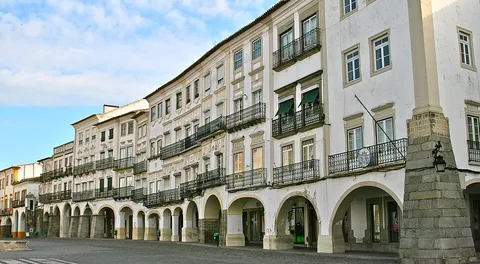
Praça do Giraldo is a useful orientation point and an easy place to begin. From the square, the old streets climb towards the cathedral and Roman Temple. The city's tourist office is also on Praça do Giraldo; consult the Municipality of Évora tourist information for current visitor assistance.
Do not treat the walk between monuments as dead time. Whitewashed façades, arcades and changes in street level are part of the historic centre's character. Comfortable shoes matter because paving can be uneven.
Roman Temple
The Roman Temple is one of Évora's defining landmarks. Visit Portugal dates it to the first century and explains that it was connected with the imperial cult; the familiar name “Temple of Diana” is not historically accurate. The surviving columns stand in an open public space, making the site easy to include even on a tight itinerary. Read the official Visit Portugal description of the Roman Temple before visiting if you want more context.
Évora Cathedral
The cathedral sits close to the Roman Temple, so the two visits fit naturally together. Interior areas and access arrangements may differ by ticket, and religious services can affect visits. Check the official Évora Cathedral visitor information for the latest hours and admission details.
Allow time to look at the building rather than treating it as a quick photo stop. If a terrace or upper area is open and suitable for you, it can add a useful view over the city, but accessibility should be confirmed directly.
Church of São Francisco and Chapel of Bones
The Chapel of Bones forms part of the Church of São Francisco complex. Its walls and pillars are covered with human bones, creating a deliberately reflective space rather than a conventional decorative interior. It is one of Évora's best-known visits, but it deserves a respectful approach.
Admission conditions and opening periods can change. Use the official São Francisco visitor page to confirm details on the day of your trip.
Suggested one-day Évora itinerary
Morning: arrive and find your bearings
Choose an early practical departure from Lisbon and confirm the return before setting off. On arrival, walk towards Praça do Giraldo and take a few minutes to orient yourself. Continue uphill through the historic streets to the Roman Temple while energy levels and light are good.
Late morning: Roman and medieval Évora
Visit the Roman Temple area, then continue to Évora Cathedral. These landmarks are close together, which keeps the route efficient. If you want to visit a museum or an additional church, place it here only after checking that the main itinerary still has enough time.
Lunch and early afternoon
Return gradually towards the central streets for lunch. A slower meal can be part of the Alentejo experience, but transport travellers should keep the final return time in mind. Leave space in the schedule rather than assigning every minute.
Afternoon: São Francisco and the Chapel of Bones
Walk to the Church of São Francisco and visit the Chapel of Bones if it suits your interests. Afterwards, use the remaining time for Praça do Giraldo, local shops or a relaxed walk through streets missed in the morning. Start towards the station or coach stop with a buffer rather than relying on the final possible minute.
Évora and the Alentejo wine region
Évora is also part of the Alentejo wine landscape. According to the Alentejo Wine Commission, Évora is one of the eight sub-regions of the Alentejo PDO. A tasting can deepen the day, but most wine estates are not part of a simple walking circuit through the historic centre.
If wine is a priority, book directly with an estate and arrange transport in advance. Opening times, availability and tasting formats vary. Consult the Alentejo Wine Commission for official regional context. Independent travellers should avoid driving after drinking; a private tour or arranged transfer is the simpler combination.
Can you visit Évora without a car?
Yes. A direct train or intercity coach can support a full day centred on the historic area, and the main sights are close enough to connect on foot. The key limitation is not movement within central Évora but fitting the day around a fixed return service.
Without a car, adding a rural winery is more complicated and may require a taxi, a pre-arranged transfer or a guided tour. If this is your first visit and monuments are the priority, keeping the itinerary within the city is the clearest plan.
How long do you need in Évora?
Allow most of a day for the core route. A brief visit can show you Praça do Giraldo, the Roman Temple and the exterior of the cathedral, but it leaves little time for interiors, lunch or unplanned discoveries. A full day gives the city room to feel like a destination rather than a checklist.
Stay overnight if you want a slower visit, several museums, an evening in the city or a separate winery experience. The purpose of a one-day itinerary is to make sensible choices, not to claim that every part of Évora fits into a few hours.
Practical planning tips
Check both directions first: confirm your outbound and return transport before planning monument visits.
Verify official opening information: churches and visitor sites can change hours or close for services and events.
Wear supportive shoes: the historic centre is compact but includes slopes and uneven paving.
Carry water and sun protection: exposed walks can feel hot in warmer months.
Keep the route flexible: swap the order of nearby sights rather than losing the day to one closure or queue.
Plan accessibility directly: historic surfaces, steps and upper areas may require specific confirmation with each attraction.
Private tour or independent day trip?
An independent trip is a good fit if you are comfortable following transport schedules, prefer your own pace and mainly want to explore central Évora. It is normally the simpler low-cost structure because the city itself is walkable.
A private tour is a better fit when hotel pickup, historical interpretation, flexible pacing or an Alentejo winery are important. It can also reduce coordination for families or small groups. Compare what is included rather than comparing transport alone: entrance fees, meals and specific winery arrangements may be separate.
Whichever format you choose, Évora works best with a clear priority and some breathing room. Confirm current transport and attraction information, start early enough for a full day and let the historic centre connect the major sights naturally.
Common planning mistakes
Assuming every attraction has the same hours
Religious services, seasonal schedules and events can change access, so verify each official website.
Overloading the day
Combining every city sight, a long lunch and a rural winery can turn a useful day trip into a rushed itinerary.
Leaving the return unplanned
Confirm the last practical train or coach before you begin sightseeing and allow a buffer to reach the departure point.
Practical answers
Frequently Asked Questions
How far is Évora from Lisbon?
Évora is roughly 130 kilometres from Lisbon by road. Travel time varies by traffic, departure point and transport service, so check the current route or timetable for your date.
Is Évora worth a day trip from Lisbon?
Yes. Évora has a compact historic centre with the Roman Temple, cathedral, Praça do Giraldo and Chapel of Bones close enough to combine in a full day. Starting early gives you a more comfortable pace.
Can you travel from Lisbon to Évora by train?
Yes. Comboios de Portugal operates an Intercidades route linking Lisbon and Évora. Check the official CP journey planner for the timetable, fares and stations on your travel date.
Can you visit Évora without a car?
Yes. Direct train and intercity coach options make a city-centre day trip possible without a car, and the principal historic sights can be connected on foot.
How long should you spend in Évora?
Allow most of a day for the central landmarks, lunch and a comfortable walking route. An overnight stay is better if you want several museums, a slower pace or a separate winery visit.
What are the main sights for one day in Évora?
A practical first-day route includes Praça do Giraldo, the Roman Temple, Évora Cathedral, the historic streets and the Church of São Francisco with the Chapel of Bones.
Is central Évora walkable?
Yes. The main historic landmarks are concentrated in a compact area, although there are slopes and uneven traditional paving. Comfortable footwear is recommended.
Can you include an Alentejo wine tasting in the same day?
It is possible, but most estates require separate transport and advance planning. Combining the city and a winery is easier with an arranged transfer or private tour, especially because nobody tasting wine should drive.
Do you need to book Évora attractions in advance?
Requirements vary by attraction and date. Check the official cathedral and Church of São Francisco websites before travel, particularly for opening hours, admission details and any service-related closures.