[{"callouts":[],"canonical":"https://listours.pt/guides/how-to-visit-obidos-from-lisbon-the-complete-day-trip-guide/","comparison_blocks":[],"content":"\u003cblockquote class=\"guide-callout\">\u003cstrong>Key Takeaways\u003c/strong> - Óbidos is approximately 80 km north of Lisbon and reachable in under two hours by car, bus, or train - The hilltop village is famous for its intact medieval walls, cobblestone streets, and the cherry liqueur \u003cem>ginjinha\u003c/em> served in chocolate cups - Entry to the village and its walls is free; the Castle (now a pousada) is not open for general interior visits - The best time to visit is on a weekday morning in spring or autumn to avoid crowds - A full day trip comfortably covers the walls, the main street \u003cem>Rua Direita\u003c/em>, the Church of Santa Maria, and lunch\u003c/blockquote>\n\u003ch2>Getting to Óbidos from Lisbon\u003c/h2>\n\u003cp>Óbidos sits about 80 km north of Lisbon in the Oeste region of central Portugal. There are three practical ways to make the journey.\u003c/p>\n\u003ch3>By Car\u003c/h3>\n\u003cp>Driving is the most flexible option. Take the A8 motorway north from Lisbon toward Caldas da Rainha and exit at the Óbidos junction. The drive takes roughly 55–70 minutes depending on Lisbon traffic. Parking is available just outside the main Porta da Vila gate at no charge.\u003c/p>\n\u003ch3>By Bus\u003c/h3>\n\u003cp>Rede Expressos and Rodoviária do Oeste operate coach services from Lisbon's Sete Rios bus terminal to Óbidos. Journey time is approximately 75–90 minutes. Check current schedules and fares directly on the operator's websites, as timetables are updated seasonally.\u003c/p>\n\u003cdiv class=\"guide-comparison overflow-x-auto my-10\">\u003ctable class=\"w-full min-w-[620px] border-collapse text-left text-sm\">\u003cthead>\u003ctr>\u003cth>Route\u003c/th>\u003cth>Departure Point\u003c/th>\u003cth>Approx. Journey Time\u003c/th>\u003c/tr>\u003c/thead>\u003ctbody>\u003ctr>\u003ctd>Coach (Rede Expressos / Rodoviária)\u003c/td>\u003ctd>Sete Rios bus terminal\u003c/td>\u003ctd>75–90 min\u003c/td>\u003c/tr>\u003ctr>\u003ctd>Car (A8 motorway)\u003c/td>\u003ctd>Lisbon city centre\u003c/td>\u003ctd>55–70 min\u003c/td>\u003c/tr>\u003ctr>\u003ctd>Train + Taxi\u003c/td>\u003ctd>Lisbon Oriente / Santa Apolónia → Caldas da Rainha\u003c/td>\u003ctd>90–110 min total\u003c/td>\u003c/tr>\u003c/tbody>\u003c/table>\u003c/div>\n\u003ch3>By Train\u003c/h3>\n\u003cp>Comboios de Portugal (CP) runs trains from Lisbon (Oriente or Santa Apolónia) to Caldas da Rainha, the nearest rail station. From Caldas da Rainha, a short taxi ride or local bus covers the remaining 6 km to Óbidos. The train leg alone takes around 80 minutes; factor in the onward connection when planning your day.\u003c/p>\n\u003ch2>Arriving in Óbidos: First Steps\u003c/h2>\n\u003cp>The village is entered through the \u003cstrong>Porta da Vila\u003c/strong>, a Baroque-tiled gateway on the southern side of the walls. Walking through it for the first time — the blue-and-white \u003cem>azulejo\u003c/em> panels line the arched passage — sets the tone for the day.\u003c/p>\n\u003cp>Leave your car in the free car park directly below the walls before the gate. The village itself is pedestrianised and very small: the main street, \u003cem>Rua Direita\u003c/em>, runs straight from the southern gate to the base of the castle at the northern end and takes roughly five minutes to walk end to end at a brisk pace.\u003c/p>\n\u003ch2>What to See and Do\u003c/h2>\n\u003ch3>Walk the Medieval Walls\u003c/h3>\n\u003cp>The circuit of walls enclosing Óbidos dates largely from the 12th and 13th centuries, though the settlement's origins are older. A path runs along the top of the ramparts, offering unobstructed views over the terracotta rooftops, the lagoon (\u003cem>Lagoa de Óbidos\u003c/em>) to the west, and the surrounding farmland. The walk around the full perimeter takes 30–45 minutes at a relaxed pace. There are no railings on sections of the wall, so take care with young children and in wet weather.\u003c/p>\n\u003ch3>Rua Direita and the Village Centre\u003c/h3>\n\u003cp>\u003cem>Rua Direita\u003c/em> is the spine of the village: whitewashed houses edged in yellow and blue, bougainvillea in season, and a concentrated stretch of ceramics shops, bookshops, and cafés. The \u003cstrong>Livraria de Santiago\u003c/strong> — a bookshop installed inside the deconsecrated Igreja de São Tiago — is worth a stop even if you are not buying.\u003c/p>\n\u003ch3>Igreja de Santa Maria\u003c/h3>\n\u003cp>The Church of Santa Maria, facing the main square (\u003cem>Praça de Santa Maria\u003c/em>), is one of Portugal's better-known examples of the Renaissance-meets-Manueline parish church. Its interior walls are covered floor to ceiling in 17th-century blue \u003cem>azulejos\u003c/em>. It also contains a painting by Josefa de Óbidos (c. 1630–1684), a significant Portuguese Baroque painter whose work appears in several of the village's religious buildings. Entry is generally free.\u003c/p>\n\u003ch3>The Castle\u003c/h3>\n\u003cp>The castle at the northern end of the village dates from the Moorish period and was substantially rebuilt under Dom Dinis in the late 13th century. It has operated as a state-run \u003cem>pousada\u003c/em> (heritage hotel) for decades and is not open for general sightseeing inside. The exterior and the connecting towers are visible from the walls walk.\u003c/p>\n\u003ch2>Ginjinha de Óbidos\u003c/h2>\n\u003cp>Óbidos is the origin of the custom of serving \u003cem>ginjinha\u003c/em> — a sour cherry liqueur made with \u003cem>ginja\u003c/em> berries, aguardente, and sugar — in small cups made from dark chocolate. You drink the liqueur and then eat the cup. Nearly every shop on \u003cem>Rua Direita\u003c/em> sells them; the price is typically €1–2 per cup. This is one of those things that is worth doing once, ideally mid-morning before the afternoon coach groups arrive.\u003c/p>\n\u003ch2>Where to Eat\u003c/h2>\n\u003cp>The village has a compact selection of restaurants clustered around the main square and along \u003cem>Rua Direita\u003c/em>. Óbidos sits in a region known for good fresh fish (the lagoon and the Atlantic coast are close), \u003cem>arroz de lingueirão\u003c/em> (razor clam rice), and local wines from the Óbidos DOC. Book ahead for weekend lunches in summer; on a weekday the main square restaurants are manageable without a reservation.\u003c/p>\n\u003cp>For a quicker option, several bakeries near the gate sell \u003cem>pastéis de nata\u003c/em> and sandwiches suitable for eating on the walls.\u003c/p>\n\u003ch2>When to Go\u003c/h2>\n\u003cdiv class=\"guide-comparison overflow-x-auto my-10\">\u003ctable class=\"w-full min-w-[620px] border-collapse text-left text-sm\">\u003cthead>\u003ctr>\u003cth>Season\u003c/th>\u003cth>Conditions\u003c/th>\u003cth>Notes\u003c/th>\u003c/tr>\u003c/thead>\u003ctbody>\u003ctr>\u003ctd>Spring (Mar–May)\u003c/td>\u003ctd>Mild, flowers on the walls, manageable crowds\u003c/td>\u003ctd>Best overall window\u003c/td>\u003c/tr>\u003ctr>\u003ctd>Summer (Jun–Aug)\u003c/td>\u003ctd>Hot, peak crowds, medieval fair in July\u003c/td>\u003ctd>Book restaurants ahead; go early\u003c/td>\u003c/tr>\u003ctr>\u003ctd>Autumn (Sep–Nov)\u003c/td>\u003ctd>Cooler, fewer tourists, good light\u003c/td>\u003ctd>Excellent for photography\u003c/td>\u003c/tr>\u003ctr>\u003ctd>Winter (Dec–Feb)\u003c/td>\u003ctd>Quiet, occasional Christmas market (Dec)\u003c/td>\u003ctd>Some cafés close on weekdays\u003c/td>\u003c/tr>\u003c/tbody>\u003c/table>\u003c/div>\n\u003cp>Weekdays are noticeably quieter than weekends throughout the year. If you are visiting in summer, aim to arrive by 10:00 to walk the walls before the midday heat and the tour buses.\u003c/p>\n\u003ch2>Practical Information\u003c/h2>\n\u003cdiv class=\"guide-comparison overflow-x-auto my-10\">\u003ctable class=\"w-full min-w-[620px] border-collapse text-left text-sm\">\u003cthead>\u003ctr>\u003cth>Detail\u003c/th>\u003cth>Information\u003c/th>\u003c/tr>\u003c/thead>\u003ctbody>\u003ctr>\u003ctd>Entry to the village\u003c/td>\u003ctd>Free\u003c/td>\u003c/tr>\u003ctr>\u003ctd>Walls walk\u003c/td>\u003ctd>Free\u003c/td>\u003c/tr>\u003ctr>\u003ctd>Igreja de Santa Maria\u003c/td>\u003ctd>Generally free\u003c/td>\u003c/tr>\u003ctr>\u003ctd>Parking outside the gate\u003c/td>\u003ctd>Free\u003c/td>\u003c/tr>\u003ctr>\u003ctd>Nearest petrol station\u003c/td>\u003ctd>Caldas da Rainha (6 km)\u003c/td>\u003c/tr>\u003ctr>\u003ctd>ATM\u003c/td>\u003ctd>Available on Rua Direita\u003c/td>\u003c/tr>\u003ctr>\u003ctd>Tourist office\u003c/td>\u003ctd>Just inside Porta da Vila\u003c/td>\u003c/tr>\u003c/tbody>\u003c/table>\u003c/div>\n\u003cp>Óbidos is small enough that a half day covers the main sights comfortably. A full day allows for a proper lunch, a slower walk of the walls, and time in the surrounding countryside or a short drive to the lagoon. There is no admission fee to enter the village.\u003c/p>\n\u003ch2>Combining Óbidos with Nearby Stops\u003c/h2>\n\u003cp>If you are driving, Óbidos pairs naturally with a couple of nearby destinations on the same day:\u003c/p>\n\u003cul>\u003cli>\u003cstrong>Caldas da Rainha\u003c/strong> (6 km): market town with a notable fruit-and-vegetable market and the Museu de Cerâmica featuring the deliberately crude pottery tradition associated with Rafael Bordalo Pinheiro\u003c/li>\u003cli>\u003cstrong>Lagoa de Óbidos\u003c/strong> (10 km west): a large tidal lagoon popular for windsurfing and seafood restaurants; the estuary village of Foz do Arelho sits at the Atlantic end\u003c/li>\u003cli>\u003cstrong>Alcobaça\u003c/strong> (35 km northeast): the UNESCO-listed Cistercian monastery, one of Portugal's most important Gothic buildings\u003c/li>\u003c/ul>\n\u003ch2>Getting Back to Lisbon\u003c/h2>\n\u003cp>Return buses from Óbidos to Lisbon run through the late afternoon and evening; confirm the last departure time before you go, as the final service can be earlier than expected in the off-season. If you are driving, the A8 southbound back to Lisbon is straightforward; allow extra time if returning on a Sunday evening when traffic builds approaching the city.\u003c/p>\n\u003ch2>Frequently Asked Questions\u003c/h2>\n\u003ch3>Is Óbidos worth visiting as a day trip from Lisbon?\u003c/h3>\n\u003cp>Yes. The village is compact and well-preserved, and the combination of the walls walk, the tiled church, and the \u003cem>ginjinha\u003c/em> tradition makes for a genuinely distinctive half or full day. It is one of the more photogenic villages in central Portugal.\u003c/p>\n\u003ch3>How long should I spend in Óbidos?\u003c/h3>\n\u003cp>Two to three hours covers the walls, \u003cem>Rua Direita\u003c/em>, and the church. Add an hour for a sit-down lunch and you have a comfortable half-day itinerary. A full day makes sense if you combine it with the lagoon or Caldas da Rainha.\u003c/p>\n\u003ch3>Is Óbidos free to visit?\u003c/h3>\n\u003cp>Entry to the village and the walls walk is free. The castle interior is a hotel and not open to general visitors. Parking outside the gate is free.\u003c/p>\n\u003ch3>Can I visit Óbidos without a car?\u003c/h3>\n\u003cp>Yes. Direct coaches run from Lisbon's Sete Rios terminal. The train to Caldas da Rainha plus a short taxi connection is a workable alternative, though it adds time and a transfer.\u003c/p>\n\u003ch3>What is the best time of year to visit Óbidos?\u003c/h3>\n\u003cp>Spring (March to May) and autumn (September to November) offer the most comfortable temperatures and smaller crowds. Summer is busy and hot; winter is quiet but some businesses have reduced hours.\u003c/p>\n\u003cp>Óbidos is one of those places that earns its reputation. The medieval circuit walls, the \u003cem>azulejo\u003c/em>-covered church, and the chocolate \u003cem>ginjinha\u003c/em> cups are not tourist confections — they are part of a living village that has managed its scale well. From Lisbon it is an easy morning start, lunch on the square, and home before dark.\u003c/p>","content_hash":"57353c5bbe687205e3168034b131119b223b786a235248a6b4277082891af1c7","content_images":[],"contextual_cta":{"body":"Ask LisTours to shape an itinerary around your interests, pace, and time in Portugal.","eyebrow":"Tailor-made Portugal","href":"/contact/","label":"Inquire Now","title":"Turn your research into a private journey"},"created_at":"2026-08-26T19:44:03.559396+00:00","destination":"Obidos","editorial_format_version":0,"excerpt":"Óbidos sits about 80 km north of Lisbon in the Oeste region of central Portugal. There are three practical ways to make the journey.","faq":[],"featured_image":{"alt":"Obidos's historic walls and whitewashed buildings under a clear summer sky.","asset_id":"pexels-19808191-5b8b737d73d9","checksum":"5b8b737d73d95e654c5fbe117d3259a449b86f5789ebe3773b114788b29b9ae1","content_hash":"5b8b737d73d95e654c5fbe117d3259a449b86f5789ebe3773b114788b29b9ae1","destination":"Obidos","format":"webp","height":1253,"path":"/images/guides/how-to-visit-obidos-from-lisbon-the-complete-day-trip-guide-pexels-19808191-5b8b737d73d9.webp","photographer":"Nuno Magalhães","provider":"pexels","source_page":"https://www.pexels.com/photo/view-of-houses-and-old-city-walls-of-obidos-portugal-19808191/","src":"/images/guides/how-to-visit-obidos-from-lisbon-the-complete-day-trip-guide-pexels-19808191-5b8b737d73d9.webp","subjects":["Obidos","Portugal"],"usage":"hero","validated":true,"width":1880},"guide_images":{"hero":{"alt":"Obidos's historic walls and whitewashed buildings under a clear summer sky.","asset_id":"pexels-19808191-5b8b737d73d9","checksum":"5b8b737d73d95e654c5fbe117d3259a449b86f5789ebe3773b114788b29b9ae1","content_hash":"5b8b737d73d95e654c5fbe117d3259a449b86f5789ebe3773b114788b29b9ae1","destination":"Obidos","format":"webp","height":1253,"path":"/images/guides/how-to-visit-obidos-from-lisbon-the-complete-day-trip-guide-pexels-19808191-5b8b737d73d9.webp","photographer":"Nuno Magalhães","provider":"pexels","source_page":"https://www.pexels.com/photo/view-of-houses-and-old-city-walls-of-obidos-portugal-19808191/","src":"/images/guides/how-to-visit-obidos-from-lisbon-the-complete-day-trip-guide-pexels-19808191-5b8b737d73d9.webp","subjects":["Obidos","Portugal"],"usage":"hero","validated":true,"width":1880},"inline":[],"requested_inline":0,"schema_version":1,"selected_inline":0,"shortfall_reason":null},"hero_image":{"alt":"Obidos's historic walls and whitewashed buildings under a clear summer sky.","asset_id":"pexels-19808191-5b8b737d73d9","checksum":"5b8b737d73d95e654c5fbe117d3259a449b86f5789ebe3773b114788b29b9ae1","content_hash":"5b8b737d73d95e654c5fbe117d3259a449b86f5789ebe3773b114788b29b9ae1","destination":"Obidos","format":"webp","height":1253,"path":"/images/guides/how-to-visit-obidos-from-lisbon-the-complete-day-trip-guide-pexels-19808191-5b8b737d73d9.webp","photographer":"Nuno Magalhães","provider":"pexels","source_page":"https://www.pexels.com/photo/view-of-houses-and-old-city-walls-of-obidos-portugal-19808191/","src":"/images/guides/how-to-visit-obidos-from-lisbon-the-complete-day-trip-guide-pexels-19808191-5b8b737d73d9.webp","subjects":["Obidos","Portugal"],"usage":"hero","validated":true,"width":1880},"image":{"alt":"Obidos's historic walls and whitewashed buildings under a clear summer sky.","asset_id":"pexels-19808191-5b8b737d73d9","checksum":"5b8b737d73d95e654c5fbe117d3259a449b86f5789ebe3773b114788b29b9ae1","content_hash":"5b8b737d73d95e654c5fbe117d3259a449b86f5789ebe3773b114788b29b9ae1","destination":"Obidos","format":"webp","height":1253,"path":"/images/guides/how-to-visit-obidos-from-lisbon-the-complete-day-trip-guide-pexels-19808191-5b8b737d73d9.webp","photographer":"Nuno Magalhães","provider":"pexels","source_page":"https://www.pexels.com/photo/view-of-houses-and-old-city-walls-of-obidos-portugal-19808191/","src":"/images/guides/how-to-visit-obidos-from-lisbon-the-complete-day-trip-guide-pexels-19808191-5b8b737d73d9.webp","subjects":["Obidos","Portugal"],"usage":"hero","validated":true,"width":1880},"meta_description":"Óbidos sits about 80 km north of Lisbon in the Oeste region of central Portugal. There are three practical ways to make the journey.","meta_title":"How to Visit Óbidos from Lisbon: The Complete Day Trip Guide","mistakes":[],"published_at":"2026-08-26T19:53:49.418488+00:00","quick_facts":[],"related_guides":[],"related_tours":["fatima-tour"],"schema_version":1,"search_intent":{"confidence":1,"intent":"INFORMATIONAL","reason":"Explicitly approved blog Guide"},"semantic_sections":[],"slug":"how-to-visit-obidos-from-lisbon-the-complete-day-trip-guide","source":"claude-blog-approved-artifact","status":"PUBLISHED","target_query":"How to Visit Óbidos from Lisbon: The Complete Day Trip Guide","title":"How to Visit Óbidos from Lisbon: The Complete Day Trip Guide","updated_at":"2026-08-26T19:53:49.418488+00:00","version":1},{"schema_version":1,"slug":"how-to-visit-lisbon-the-complete-travel-guide","title":"One Day in Lisbon: A Practical Itinerary","excerpt":"Plan one day in Lisbon with a realistic route through Alfama, Baixa, Chiado and Belém, including practical advice on walking, transport and what to skip.","canonical":"https://listours.pt/guides/how-to-visit-lisbon-the-complete-travel-guide/","destination":"Lisbon","image":{"alt":"Lisbon cityscape and hillside neighbourhoods under a clear blue sky","asset_id":"pexels-4330076-828e1a27b3b1","checksum":"828e1a27b3b1fc9afe0563fd9699e3795c2c8db6f5bccee9bd7bdb561d6f39e0","content_hash":"828e1a27b3b1fc9afe0563fd9699e3795c2c8db6f5bccee9bd7bdb561d6f39e0","destination":"Lisbon","format":"webp","height":1254,"path":"/images/guides/how-to-visit-lisbon-the-complete-travel-guide-pexels-4330076-828e1a27b3b1.webp","photographer":"ArtHouse Studio","provider":"pexels","source_page":"https://www.pexels.com/photo/scenic-cityscape-of-lisbon-under-blue-summer-sky-4330076/","src":"/images/guides/how-to-visit-lisbon-the-complete-travel-guide-pexels-4330076-828e1a27b3b1.webp","subjects":["Lisbon","Portugal"],"usage":"hero","validated":true,"width":1880},"related_tours":["private-lisbon-tour"],"published_at":"2026-08-27T07:42:02.735029+00:00","updated_at":"2026-09-27T23:30:00+01:00"}]
Travel Guide · Obidos
How to Visit Óbidos from Lisbon: The Complete Day Trip Guide
Óbidos sits about 80 km north of Lisbon in the Oeste region of central Portugal. There are three practical ways to make the journey.
Key Takeaways - Óbidos is approximately 80 km north of Lisbon and reachable in under two hours by car, bus, or train - The hilltop village is famous for its intact medieval walls, cobblestone streets, and the cherry liqueur ginjinha served in chocolate cups - Entry to the village and its walls is free; the Castle (now a pousada) is not open for general interior visits - The best time to visit is on a weekday morning in spring or autumn to avoid crowds - A full day trip comfortably covers the walls, the main street Rua Direita, the Church of Santa Maria, and lunch
Getting to Óbidos from Lisbon
Óbidos sits about 80 km north of Lisbon in the Oeste region of central Portugal. There are three practical ways to make the journey.
By Car
Driving is the most flexible option. Take the A8 motorway north from Lisbon toward Caldas da Rainha and exit at the Óbidos junction. The drive takes roughly 55–70 minutes depending on Lisbon traffic. Parking is available just outside the main Porta da Vila gate at no charge.
By Bus
Rede Expressos and Rodoviária do Oeste operate coach services from Lisbon's Sete Rios bus terminal to Óbidos. Journey time is approximately 75–90 minutes. Check current schedules and fares directly on the operator's websites, as timetables are updated seasonally.
Route
Departure Point
Approx. Journey Time
Coach (Rede Expressos / Rodoviária)
Sete Rios bus terminal
75–90 min
Car (A8 motorway)
Lisbon city centre
55–70 min
Train + Taxi
Lisbon Oriente / Santa Apolónia → Caldas da Rainha
90–110 min total
By Train
Comboios de Portugal (CP) runs trains from Lisbon (Oriente or Santa Apolónia) to Caldas da Rainha, the nearest rail station. From Caldas da Rainha, a short taxi ride or local bus covers the remaining 6 km to Óbidos. The train leg alone takes around 80 minutes; factor in the onward connection when planning your day.
Arriving in Óbidos: First Steps
The village is entered through the Porta da Vila, a Baroque-tiled gateway on the southern side of the walls. Walking through it for the first time — the blue-and-white azulejo panels line the arched passage — sets the tone for the day.
Leave your car in the free car park directly below the walls before the gate. The village itself is pedestrianised and very small: the main street, Rua Direita, runs straight from the southern gate to the base of the castle at the northern end and takes roughly five minutes to walk end to end at a brisk pace.
What to See and Do
Walk the Medieval Walls
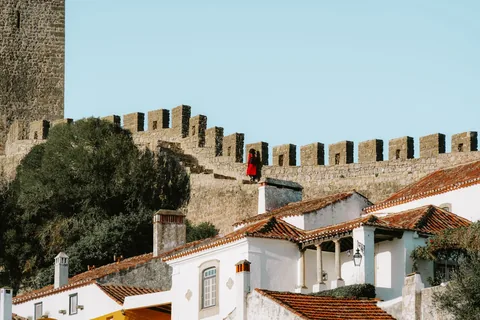
The circuit of walls enclosing Óbidos dates largely from the 12th and 13th centuries, though the settlement's origins are older. A path runs along the top of the ramparts, offering unobstructed views over the terracotta rooftops, the lagoon (Lagoa de Óbidos) to the west, and the surrounding farmland. The walk around the full perimeter takes 30–45 minutes at a relaxed pace. There are no railings on sections of the wall, so take care with young children and in wet weather.
Rua Direita and the Village Centre
Rua Direita is the spine of the village: whitewashed houses edged in yellow and blue, bougainvillea in season, and a concentrated stretch of ceramics shops, bookshops, and cafés. The Livraria de Santiago — a bookshop installed inside the deconsecrated Igreja de São Tiago — is worth a stop even if you are not buying.
Igreja de Santa Maria
The Church of Santa Maria, facing the main square (Praça de Santa Maria), is one of Portugal's better-known examples of the Renaissance-meets-Manueline parish church. Its interior walls are covered floor to ceiling in 17th-century blue azulejos. It also contains a painting by Josefa de Óbidos (c. 1630–1684), a significant Portuguese Baroque painter whose work appears in several of the village's religious buildings. Entry is generally free.
The Castle
The castle at the northern end of the village dates from the Moorish period and was substantially rebuilt under Dom Dinis in the late 13th century. It has operated as a state-run pousada (heritage hotel) for decades and is not open for general sightseeing inside. The exterior and the connecting towers are visible from the walls walk.
Ginjinha de Óbidos
Óbidos is the origin of the custom of serving ginjinha — a sour cherry liqueur made with ginja berries, aguardente, and sugar — in small cups made from dark chocolate. You drink the liqueur and then eat the cup. Nearly every shop on Rua Direita sells them; the price is typically €1–2 per cup. This is one of those things that is worth doing once, ideally mid-morning before the afternoon coach groups arrive.
Where to Eat
The village has a compact selection of restaurants clustered around the main square and along Rua Direita. Óbidos sits in a region known for good fresh fish (the lagoon and the Atlantic coast are close), arroz de lingueirão (razor clam rice), and local wines from the Óbidos DOC. Book ahead for weekend lunches in summer; on a weekday the main square restaurants are manageable without a reservation.
For a quicker option, several bakeries near the gate sell pastéis de nata and sandwiches suitable for eating on the walls.
When to Go
Season
Conditions
Notes
Spring (Mar–May)
Mild, flowers on the walls, manageable crowds
Best overall window
Summer (Jun–Aug)
Hot, peak crowds, medieval fair in July
Book restaurants ahead; go early
Autumn (Sep–Nov)
Cooler, fewer tourists, good light
Excellent for photography
Winter (Dec–Feb)
Quiet, occasional Christmas market (Dec)
Some cafés close on weekdays
Weekdays are noticeably quieter than weekends throughout the year. If you are visiting in summer, aim to arrive by 10:00 to walk the walls before the midday heat and the tour buses.
Practical Information
Detail
Information
Entry to the village
Free
Walls walk
Free
Igreja de Santa Maria
Generally free
Parking outside the gate
Free
Nearest petrol station
Caldas da Rainha (6 km)
ATM
Available on Rua Direita
Tourist office
Just inside Porta da Vila
Óbidos is small enough that a half day covers the main sights comfortably. A full day allows for a proper lunch, a slower walk of the walls, and time in the surrounding countryside or a short drive to the lagoon. There is no admission fee to enter the village.
Combining Óbidos with Nearby Stops
If you are driving, Óbidos pairs naturally with a couple of nearby destinations on the same day:
Caldas da Rainha (6 km): market town with a notable fruit-and-vegetable market and the Museu de Cerâmica featuring the deliberately crude pottery tradition associated with Rafael Bordalo Pinheiro
Lagoa de Óbidos (10 km west): a large tidal lagoon popular for windsurfing and seafood restaurants; the estuary village of Foz do Arelho sits at the Atlantic end
Alcobaça (35 km northeast): the UNESCO-listed Cistercian monastery, one of Portugal's most important Gothic buildings
Getting Back to Lisbon
Return buses from Óbidos to Lisbon run through the late afternoon and evening; confirm the last departure time before you go, as the final service can be earlier than expected in the off-season. If you are driving, the A8 southbound back to Lisbon is straightforward; allow extra time if returning on a Sunday evening when traffic builds approaching the city.
Frequently Asked Questions
Is Óbidos worth visiting as a day trip from Lisbon?
Yes. The village is compact and well-preserved, and the combination of the walls walk, the tiled church, and the ginjinha tradition makes for a genuinely distinctive half or full day. It is one of the more photogenic villages in central Portugal.
How long should I spend in Óbidos?
Two to three hours covers the walls, Rua Direita, and the church. Add an hour for a sit-down lunch and you have a comfortable half-day itinerary. A full day makes sense if you combine it with the lagoon or Caldas da Rainha.
Is Óbidos free to visit?
Entry to the village and the walls walk is free. The castle interior is a hotel and not open to general visitors. Parking outside the gate is free.
Can I visit Óbidos without a car?
Yes. Direct coaches run from Lisbon's Sete Rios terminal. The train to Caldas da Rainha plus a short taxi connection is a workable alternative, though it adds time and a transfer.
What is the best time of year to visit Óbidos?
Spring (March to May) and autumn (September to November) offer the most comfortable temperatures and smaller crowds. Summer is busy and hot; winter is quiet but some businesses have reduced hours.
Óbidos is one of those places that earns its reputation. The medieval circuit walls, the azulejo-covered church, and the chocolate ginjinha cups are not tourist confections — they are part of a living village that has managed its scale well. From Lisbon it is an easy morning start, lunch on the square, and home before dark.